Marion Leleu loves the sound of the viola. In the musical questionnaire, she helps you to find the right instrument and discover the soul of the viola.
4/17/2025

Learning to play the viola – 20 Questions with Marion Leleu
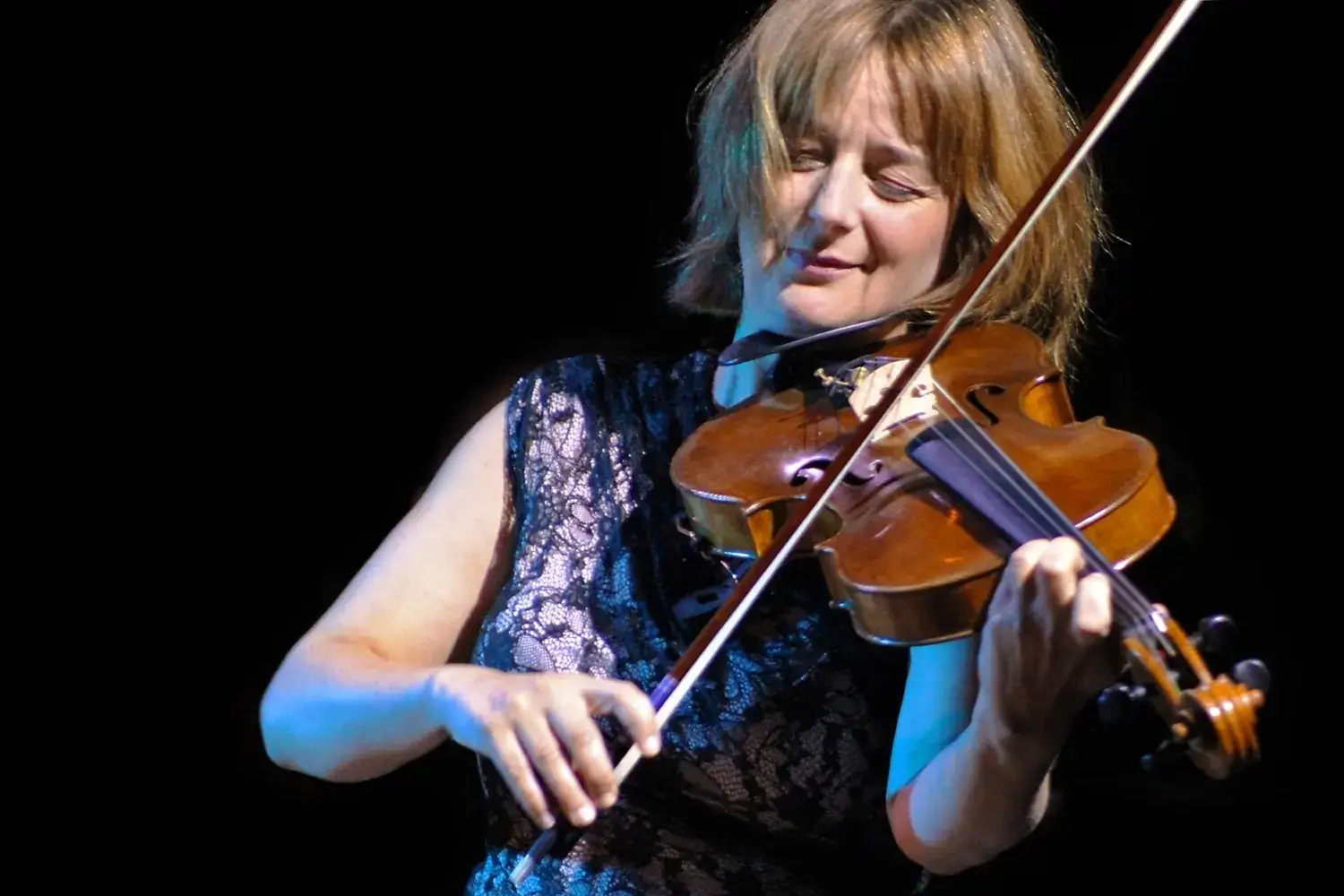
(15.12.2023)

Marion Leleu |

Marion Leleu started learning the viola at the age of 4. She studied viola and choral conducting at the CNSM in Lyon and graduated with honors. She initially worked for many years as an orchestral musician, including at the Hamburg State Opera and the Chamber Academy Potsdam, but also in many other ensembles where she was a guest. These include the Chamber Orchestra of Europe, the Orchestre de Radio-France, Ensemble Modern, the Bavarian State Opera, the Dresden State Opera, and the Academy of Ancient Music Berlin. Since 2008, she has been passing on the stage experience she gained there at the UdK Berlin. She also teaches viola at the Leo Gerstenberg Music School and at the Hanns Eisler School of Music Berlin, where she has focused on pedagogy and teaching practice for high string instruments since 2017.
Her passion lies in pedagogy and the psychological support of other musicians to help them achieve their best performance. Her coaching method is based on tapping acupressure techniques and positive visualization. She has conducted several advanced training sessions and workshops for instrumentalists and is a sought-after speaker and lecturer in this field both nationally and internationally.
As a musician still passionately active, she has shifted her concert activities to challenging chamber music, in various formations, but especially with her duo partner Bertrand Giraud, with whom she recorded the CD "1919" in 2023.

“I love the melancholic sound of the viola. It is perfect for expressing all states of the soul. In terms of pitch, the viola is close to the human voice: the high strings like a female voice and the low strings like a male voice.”

REQUIREMENTS

What is the perfect starting age?

A good start is possible for children from the age of 5. The advantage of such a young age is that the brain adapts wonderfully to its tasks and, for example, dedicates a particularly large area to the perception of the thumb.
However, at this age, cognitive instruction is still not possible, and progress is initially slow. If the child starts a bit later, for example from 8 years old, the instruction can already be more demanding, and one can then "practice with a brain," as I like to say.

Do I need to learn to read music?

There is always the possibility to play by ear what the teacher plays without particularly orienting oneself to a text. After all, oral transmission in music has a long tradition and still works today.
However, those who wish to learn demanding pieces would benefit from learning to read notes and rhythms. Nowadays, there are also practical and user-friendly apps that can teach these concepts in a playful way.
Learners should make use of these opportunities so that valuable lesson time is not spent on this. There are "only" 12 tones in Western music, and anyone who has successfully learned to read 26 letters will likely be able to do the same with notes.

Are there instruments that are played in the same way?

The violin is played in a similar way to the viola, as are the viola d’amore with twelve strings and the viola da spalla with five strings.

What physical prerequisites are advantageous?

Important for all instruments are a good ear, which can be developed through singing, and a sensitive body awareness. Naturally, as with all string instruments, fine motor skills and eye-hand coordination are especially developed.

How can one tell if they are ready for the instrument?

It is best to introduce children of elementary school age to various instruments they can try out. There are differences in inclinations and talents. Who can predict in advance whether a child has the aptitude for a string or wind instrument, piano, or drums?
A good option is the so-called instrument carousel in music schools, where the child can try out an instrument provided by the school for several weeks. This also allows the child to meet several teachers. This is particularly important because the relationship with the teacher is one of the most important factors (if not the most important) for motivation.

External content from YouTube

We need your consent to display this content because personal data is transferred to the platform operator (partly to the USA). You can revoke your consent at any time. You can find more information here: Privacy Policy.

FINANCES

What does the instrument cost?

At a young age, it is advisable to rent instruments either from the music school or from the violin maker. It usually doesn’t cost much, perhaps between €18 and €30 per month.
Once a certain body size is reached, and if the child is ready to play a "full-sized" viola, one can consider buying an instrument. You can find a decent instrument starting at €500, and a wooden bow costs at least €500. For beginners, there are affordable and durable carbon bows, with prices ranging from €250 to €1500.
For those wishing to study the instrument, one should unfortunately expect around €15,000, and several thousand euros for a good bow. The positive aspect is that instruments often increase in value with age, so it can also be seen as a kind of investment.

Are there additional costs?

In addition to the cost of the instrument and the bow, there are the costs for a set of strings per year (between €50 and €120) and bow rehairing by a bow maker (between €80 and €90).
It is very important to select the right chin rest and shoulder rest, which should be chosen according to the morphology. This is an important topic that has recently occupied me a lot. I have written an entire article on this and also made some videos for YouTube.

External content from YouTube

We need your consent to display this content because personal data is transferred to the platform operator (partly to the USA). You can revoke your consent at any time. You can find more information here: Privacy Policy.

How demanding is maintenance?

Apart from the strings and bow rehairing, the instrument is extremely stable. Many violas are several centuries old and still play excellently.
Occasionally, in winter, a spot may need to be glued because the wood contracts due to dry heating air. A good violin maker can quickly fix this for about €40.

How is the instrument transported?

In a viola case. Make sure that the case is lightweight, i.e., not over 2 kg, and fits well on the shoulders.

Sheet Music for Beginners

PRACTICE MAKES PERFECT

Can you teach yourself the instrument?

I would strongly advise against this, as a physiologically correct posture is very important and you can quickly become tense otherwise. The teacher will be glad if the student practices adequately between lessons.

How should you choose suitable practice material?

This should be left to the teacher. However, one should naturally be allowed to request a special piece or influence the style of music.

How can you practice without disturbing others?

You can use a hotel mute to practice. This heavy piece of metal or rubber dampens the sound so much that no neighbor should be disturbed. It is also not bad for the instrument, which sometimes even sounds better when you remove the mute.

What different playing techniques are there?

On a viola, you can use various techniques like on other string instruments, each producing its own tone colors, such as pizzicato or playing near the bridge.

When can you expect to see first successes?

There is beginner literature that even works with open strings and sounds quite appealing with a sophisticated piano accompaniment.
Most beginner schools nowadays have a playback (mp3 or CD), which allows you to make music together even without a second person. This is also very valuable for playing cleanly and in time from the beginning. After five to six weeks, such a piece should be playable on open strings.

AND THEN...

What are popular pieces for the first performance?

I like to use the book “Tunes for my Viola”. The pieces in it are easy and sound very beautiful.

What are the classics and what is your favorite piece?

There are many, but not all of my favorite pieces are among the most famous. I love playing the two Brahms Sonatas, Op. 120, and the Sonata by Rebecca Clarke is particularly dear to me, as well as the newly rediscovered Viola Sonata by Joseph Ryelandt, which I recorded last year with pianist Bertrand Giraud for the album "1919", I like a lot.

Which piece really makes you enthusiastic about the instrument?

The Clarke Sonata is very virtuosic and often impresses the audience. In the video from minute 39:

External content from YouTube

We need your consent to display this content because personal data is transferred to the platform operator (partly to the USA). You can revoke your consent at any time. You can find more information here: Privacy Policy.

But the solo sonatas by Paul Hindemith also showcase the instrument at its best.

External content from YouTube

We need your consent to display this content because personal data is transferred to the platform operator (partly to the USA). You can revoke your consent at any time. You can find more information here: Privacy Policy.

How can you play music with others?

The viola is a great instrument for chamber music or orchestra playing. Everything from duos with other string players, wind players, or pianists to a 90-member orchestra is possible.

What role does the instrument play in ensembles?

The viola is both an accompanist, mediator, harmonizer, and sometimes even a melody instrument.

Are there clichés about the instrument and its players?

Of course, many! In the past, it was often suggested that less talented violinists switch to the viola. This only made them a not-so-good violist. And so many viola jokes were created, such as this one:
What is the difference between lightning and the left hand of a violist?
There is none: You never know when they will come, where they will come from, and they never hit the same spot twice.
But nowadays there are so many good viola players that these jokes shouldn’t exist anymore. I still like to tell them myself!

All 20 Questions

More about the topic